


.png)

Many assume the biggest question raised by the recent barrage of AI agents going rogue is, “How do I secure against these AI agent attacks?” But that’s not the case. From the customers and prospects I’ve spoken with, the more immediate question is: “How quickly can I put policy and access controls in place for my AI agents?”
For organizations with strong engineering resources, that quickly leads to another question: Is building something in-house the fastest path, or should I buy?
At first glance, the build option looks approachable. Combine components such as Envoy, Open Policy Agent (OPA), and OpenTelemetry with the identity, security, and governance platforms already in your stack. Open-source policy languages such as Rego make it relatively straightforward to define authorization rules. A capable engineering team can get a prototype working.
But the harder question isn't whether you can build a policy engine. It's whether you can operate a policy control plane reliably and at scale for years to come.
Writing the policy is the 20 of the 80-20 rule
The policy logic itself is rarely the bottleneck. What consumes the bulk of the effort is everything required to turn those policies into a production system. That includes authorship and approval workflows, versioning and rollback, confirming that published policies actually took effect, and enforcing policies consistently across multiple layers.
Agentic environments make these tasks particularly challenging. Policy decisions may need to account for which agent can see which MCP server or tool, contextual attributes such as risk score or agent tier, the intent behind the actual arguments of a call, and row- or column-level policies inside the underlying data platform.
Individually, they may seem manageable. But together, they start looking less like a policy bundle and more like a platform.
Identity becomes part of the architecture
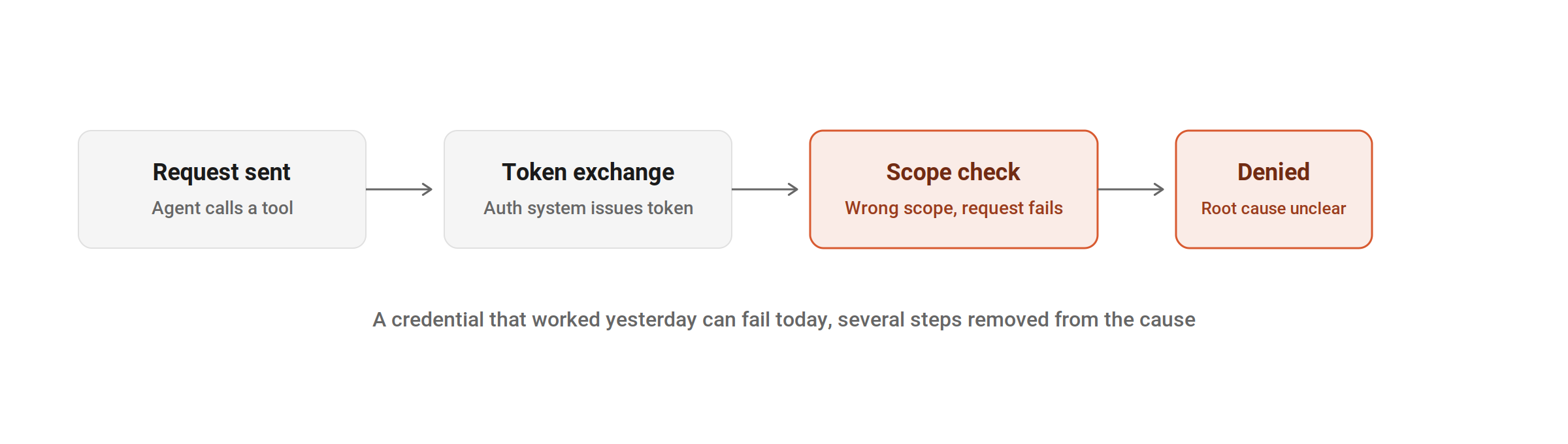
A policy decision is only as reliable as the identity behind the request. Every source system authenticates differently, with its own tokens, scopes, expiration behavior, and failure modes. Enterprise agents may require OAuth app registrations and multiple token exchanges before a request ever reaches the policy layer.
A credential with the wrong scope can work one day and fail the next. The error may appear several steps removed from the actual cause. What looks like a five-minute configuration issue can turn into a multi-day investigation.
Teams building from scratch often discover that they aren't just building authorization logic. They're also building and maintaining the identity backend required to make that logic trustworthy.
MCP and tool discovery introduce another operational layer
Let’s consider an agent connected to dozens of MCP servers across multiple environments. Some servers respond immediately while others are slow or unavailable. Some may require user interaction. Tool names can conflict. Sessions can become stale. New tools may appear. Making discovery reliable requires timeouts, retry logic, partial-result handling, naming validation, and continuous verification as MCP servers and tools are added. All these variables represent another layer of operational hurdles that must be accounted for.
Continuously moving target
The initial architecture also doesn't remain static. Snowflake, Azure, Microsoft 365, Salesforce, and other platforms continuously change APIs, authentication behavior, MCP implementations, tool names, and administrative controls. For a vendor whose product is the policy control plane, keeping up with these changes is part of the job. For an internal engineering team, it's recurring work competing with other priorities.
The same challenge applies to governance. As the environment evolves, audit requirements must continue answering questions such as: Who initiated the action? Which agent performed it? For what purpose? And which policy decision allowed it? Meanwhile, controls and audit evidence need to evolve with internal requirements and frameworks such as SOC 2, GDPR, and the EU AI Act.
This long-term care and feeding are part of the build equation that's easy to underestimate.
So, should you build or buy?
You certainly can make the case to build. A narrowly scoped internal solution for a specific environment may be exactly the right architectural choice. And organizations with strong platform engineering teams can certainly assemble a working policy and enforcement layer from open-source and existing enterprise components. But the decision shouldn't be based primarily on how quickly you can get the first version running.
As more agents, MCP endpoints, tools, data stores, and platforms come online, someone has to keep policies consistent, maintain integrations, troubleshoot identity failures, track platform changes, preserve auditability, and make sure enforcement doesn't drift. That work doesn't disappear once the initial project is complete.
So when architects evaluate build versus buy for AI agent policy control, the comparison shouldn't be software license versus initial engineering cost. It should be the total cost and architectural responsibility of operating the control plane over its useful life.
The question is not simply, “Can we build this?” For many organizations, the more relevant question is: “Is this a platform we want to own and maintain indefinitely?”
Stay in the Know
Subscribe to Our Blog

.png)