
Learn how just-in-time data access replaces standing privilege with time-bound, audited grants for sensitive data and AI agents.
Just-in-time (JIT) access for data grants a user or system entitlement to specific data for a defined, limited period, only when there is a legitimate need. Instead of standing access that persists indefinitely, JIT converts every access event into a scoped, time-bound grant that expires automatically when the task is done.
This model directly addresses the root cause behind most insider incidents and access-related audit findings: permissions that were granted once and never removed. JIT replaces that permanent attack surface with a controlled, auditable event.
Enterprises adopting JIT for data typically start with the highest-risk surface area first: sensitive tables, financial systems, and any dataset subject to regulatory scrutiny. From there, the model extends to broader data estates and, increasingly, to the AI agents and automated pipelines that now touch enterprise data alongside human users.
Just-in-time access for data is an access control model in which permissions to specific datasets are granted only for the duration required to complete a task, then automatically revoked. Access is requested, approved (or auto-approved against policy), used, and terminated, all within a defined window.
JIT differs from traditional provisioning in one key respect: it treats access as an event, not a state. A traditional model asks "does this user have access to this data warehouse role?" A JIT model asks "does this user need access to this specific table, right now, for this specific reason?"
The practical effect is a shift from broad, standing entitlements to narrow, ephemeral ones. A data analyst who needs read access to a customer table for a two-hour investigation receives exactly that: two hours, that table, nothing more.
JIT is often discussed alongside zero standing privilege, a related concept describing an end state in which no user or system retains persistent access to sensitive data by default. JIT is the mechanism that makes zero standing privilege achievable: every grant is created on demand and expires on schedule, so the resting state of the system is no access rather than broad access.
Many organizations already apply time-limited access to privileged administrative accounts but stop there. Extending the same model to everyday analyst, engineer, and service account access is what separates a narrow privileged-access-management practice from a comprehensive JIT data access program.
Standing privilege fails because access, once granted, is rarely revisited. Roles accumulate permissions over time as employees change teams, take on projects, or cover for colleagues, and those permissions are almost never cleaned up afterward.
This creates a widening gap between what people actually need and what they can actually reach. Three failure patterns show up consistently across enterprise data platforms:
Permanent "temporary" access. A grant made for a single project or incident outlives its original purpose because no one owns the revocation step.
Group and role sprawl. New roles get created to solve immediate problems rather than mapped to existing ones, and the resulting role count grows faster than any team can audit manually.
Orphaned entitlements. Access tied to a project, vendor, or contractor remains active long after the relationship ends, since offboarding processes rarely extend to every downstream data system.
Each of these turns a data platform into a wide, largely undocumented attack surface. An account compromised anywhere in that surface inherits every standing permission attached to it, regardless of whether those permissions are still relevant to that person's current work.
The audit consequence compounds the security consequence. When an auditor asks why a given user has access to a given table, the honest answer in a standing-privilege environment is often that no one remembers. Reconstructing that justification across hundreds of users and thousands of tables is the primary reason access reviews consume as much time as they do.
Periodic access recertification, the traditional remedy for standing privilege, only partially addresses the problem. A quarterly or annual review catches some stale access, but anything granted and left unused between cycles remains exposed for the full length of that cycle. JIT removes the need for recertification to catch this category of risk, since access that was never granted as a standing entitlement has nothing to recertify.
Approval workflows are what make JIT access practical at scale: they define who can request access, what triggers automatic approval versus manual review, and how long a grant remains valid before it expires.
A typical JIT approval flow follows four steps:
The value of this workflow is that it removes the two weakest points in manual access management: the decision to grant, which is now governed by consistent policy rather than ad hoc judgment, and the decision to revoke, which happens automatically rather than depending on someone remembering to do it.
The distinction between auto-approval and manual review is what keeps JIT workable at scale. If every request required a human approver, JIT would simply move the bottleneck from provisioning to approval queues, and teams would face pressure to grant broader standing access to avoid the friction. Clear, risk-based criteria for auto-approval, based on data sensitivity, requester role, and requested duration, let routine requests resolve in seconds while sensitive requests still receive human judgment. A request for a low-sensitivity reporting table might default to a 24-hour window, while one touching regulated personal data might cap at a few hours and require an explicit justification field before it can route for approval.
TrustAccess implements JIT access as a native capability across Snowflake, Databricks, and Power BI, applying fine-grained, attribute-based policies at the moment of request rather than relying on static role assignments.
When a user requests access through TrustAccess, the request is evaluated against the business context, data sensitivity, and existing policy in real time. Approved grants are time-boxed by default: TrustAccess provisions the exact scope requested and schedules automatic revocation at the end of the approved window, with no dependency on a follow-up ticket or manual review.
A representative approval workflow example: a financial analyst requests read access to a restricted transactions table for a quarter-end reconciliation task. TrustAccess evaluates the request against the analyst's role, the sensitivity classification of the table, and the stated business justification, grants access for the twelve-hour window covering the task, and revokes it automatically once that window closes. No standing entitlement to the transactions table remains afterward.
Because these policies are defined and enforced natively within each data platform rather than through a proxy layer, TrustAccess maintains this JIT model without changing the underlying architecture of the warehouse or lakehouse it governs. There is no intermediary system sitting between the user and the data, and no additional infrastructure for a security or data platform team to maintain.
TrustAccess also applies JIT logic to policy definition itself. Rather than requiring a data engineering team to hand-write a new time-bound rule for every sensitive table, TrustAccess recommends attribute-based policies from data classification and observed access patterns, which teams approve and deploy across Snowflake, Databricks, and Power BI from a single control plane. This keeps policy coverage consistent as new tables and datasets are added.
For teams migrating away from standing role assignments, TrustAccess supports a phased rollout: existing roles remain in place while JIT policies are introduced for the highest-sensitivity data first, with broader coverage extended once duration policies are tuned to actual usage.
Every JIT access event is logged with the information an auditor needs to reconstruct exactly who accessed what, when, why, and for how long, without requiring a separate reconciliation step after the fact.
A complete audit trail entry for a JIT grant typically includes:
Because each entry is generated at the moment of the access event itself, audit preparation shifts from a manual, retrospective exercise to a matter of pulling an existing, structured log. This is a direct contrast to standing-privilege environments, where proving that access was appropriate requires reconstructing intent after the fact, often long after anyone remembers the original reason for the grant.
This structure matters for compliance frameworks that require evidence of least-privilege enforcement, including SOX, HIPAA, and PCI-DSS. Auditors under these frameworks typically ask not just whether access controls exist, but whether the organization can demonstrate that access was appropriate at the time it was granted. A JIT audit log answers that directly, since the justification and approval decision are captured as part of the grant itself.
Audit trail data from JIT access events also has value beyond compliance reporting. Patterns in request volume and duration by sensitivity tier give data governance teams a real usage baseline, useful for tuning auto-approval policy and for spotting datasets that may be over-classified or under-classified relative to how they are actually accessed.
The principle of least privilege for data access means that each user, service, or agent has access only to the specific data required for their current task, and only for as long as that task requires.
In practice, least privilege breaks down at warehouse scale because granting and revoking access remains a manual process across most organizations. It is straightforward to grant a new permission when someone asks; it is much harder to reliably remove that permission once it is no longer needed, especially across dozens of roles and thousands of tables.
Two anti-patterns show up repeatedly wherever least privilege has failed in practice:
"Temporary" access that becomes permanent. A grant made to solve an immediate problem is never revisited once the problem is resolved.
Group sprawl. New groups are created to grant a specific combination of permissions, rather than reusing or refining existing ones, and the resulting proliferation of groups makes it difficult to know what any given group actually permits.
The implementation pattern that closes this gap combines JIT provisioning with continuous policy enforcement: access is granted narrowly and automatically expires, rather than being granted broadly and left for a future audit to catch.
Least privilege is frequently described as a policy goal, but without an enforcement mechanism it functions as a guideline that erodes over time. Writing "grant only the minimum access necessary" into a policy document does not change how requests are handled day to day. What changes behavior is a system that makes the minimally scoped grant the default, which is what JIT provisioning does when paired with continuous, automated enforcement rather than periodic manual review.
Static credentials are a poor fit for agents because an agent's actual need for data access is typically measured in minutes, not the 24/7 window that a standing credential provides. A static API key or service account granted broad warehouse access gives an agent far more standing reach than any individual task requires, and that gap persists for as long as the credential exists.
JIT access works for AI agents by scoping data and tool access to the duration of a single task, rather than issuing agents standing credentials that remain valid indefinitely. Task-scoped JIT access grants access at the moment an agent initiates a specific action, limited to the data and tools that action requires.
Access is automatically revoked once the task completes, with no manual cleanup step required. If an agent is compromised or behaves unexpectedly outside its intended task, the blast radius is limited to whatever narrow grant was active at that moment, not the full scope of a standing credential.
This distinction between agent-level access and tool-call-level access is significant. Granting an agent standing access at the session level still leaves a wide window open for the duration of that session, even if the individual task only needed a fraction of it.
TrustAI enforces this model at the tool-call layer, the point where an agent actually invokes a data or system operation. Each tool call is evaluated against policy in real time, access is granted for that call's scope only, and the grant is automatically revoked once the call completes, with the full event logged for audit.
This model extends to Model Context Protocol (MCP) tools, which give agents standardized access to external systems and data sources. As agentic workflows increasingly rely on MCP tools to reach enterprise data, applying the same task-scoped, auto-revoked pattern to those tool invocations keeps agent access governed at the same level of precision as the rest of the data estate.
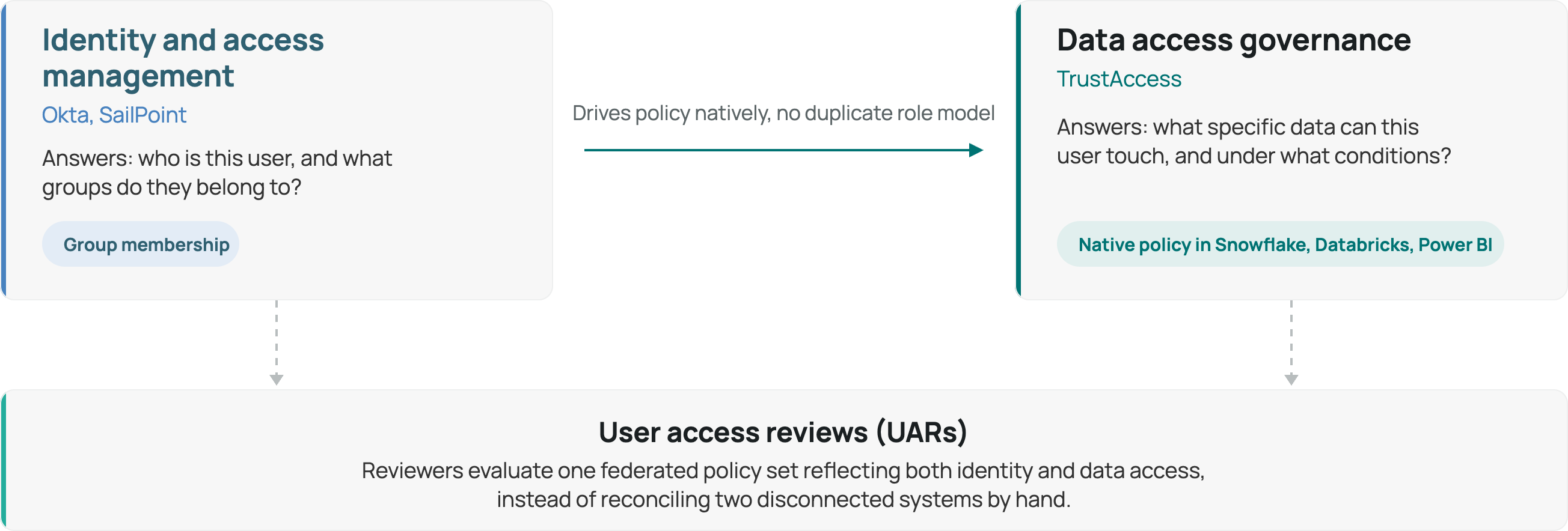
Identity and access management (IAM) platforms like Okta and SailPoint answer the question of who a user is and what groups they belong to. Data access governance answers a different question: what specific data that user can touch, and under what conditions.
Aligning the two means using IAM identity and group membership as an input into data access policy, rather than maintaining separate, disconnected role definitions in each system. Without that alignment, organizations end up building a parallel set of data-specific roles that duplicate, and often drift out of sync with, the roles already defined in IAM.
A common failure mode without this alignment: IAM manages who can log into which systems, while a separate, disconnected set of warehouse or lakehouse roles determines what data those same users can query once logged in. The two systems drift apart as each is updated independently, and catching that drift manually requires cross-referencing systems never designed to be compared directly.
Federating IAM with data access governance typically means Okta or SailPoint group membership drives policy decisions natively within Snowflake, Databricks, or Power BI, rather than requiring a separate manual mapping step maintained outside either system. When a user's IAM group changes, their data access policy updates accordingly, without a parallel change request in the data platform. This makes identity the single source of truth both systems read from.
This federation makes user access reviews (UARs) on data significantly more tractable. Instead of reconciling IAM group membership against a separate, manually maintained list of data permissions, reviewers can evaluate a single, federated policy set that reflects both identity and data access in one place.
Standing privilege is a known, well-documented risk. Just-in-time access, backed by policy enforcement and automatic revocation, is how enterprises close that gap without slowing down the analysts, engineers, and AI agents who need legitimate access to get their work done.
.png)