




The enterprises I talk to that have already put money into Microsoft's agent security stack have made a real investment: Entra Agent ID, Conditional Access, Purview, Defender. It's a serious commitment and not one anyone should walk away from. These tools do exactly what they're built to do, and they do it well.
But here's the thing about agent security: it's actually two different problems.
- The first is letting an agent into your environment safely: who is it, does it have a valid token, should this app or MCP server even be reachable.
- The second is enforcing agent acitity: once an agent is in and authorized, what is it actually allowed to do, on which tool, for what purpose, with what data coming back.
Microsoft owns the first layer. TrustLogix delivers the second. Together, that's defense in depth, not an either/or choice.
Seven controls Microsoft already gets right
Microsoft has built a strong perimeter for agents:
- Agent identity at scale, through Entra Agent ID, blueprints, and third-party onboarding
- Conditional Access on agents, evaluated at token issuance based on risk, network, and device
- Org-wide app blocking, so a whole app or MCP server can be shut off across every client
- Item-level protection, with sensitivity labels and DLP through Purview
- Real-time threat blocking, via Defender, for known threat patterns
- Audit and forensics, with unified logging and eDiscovery across tool calls
- Content safety guardrails, including prompt shield protections against jailbreaks and injection
If your organization already has this in place, keep it. None of it should go away.
The layer that sits inside the perimeter
Once an agent has a valid token and is inside the door, something still has to decide what it can do next. That's a different kind of decision, and it happens at a different speed: per tool call, per argument, per stated purpose. This is where TrustLogix TrustAI comes in.
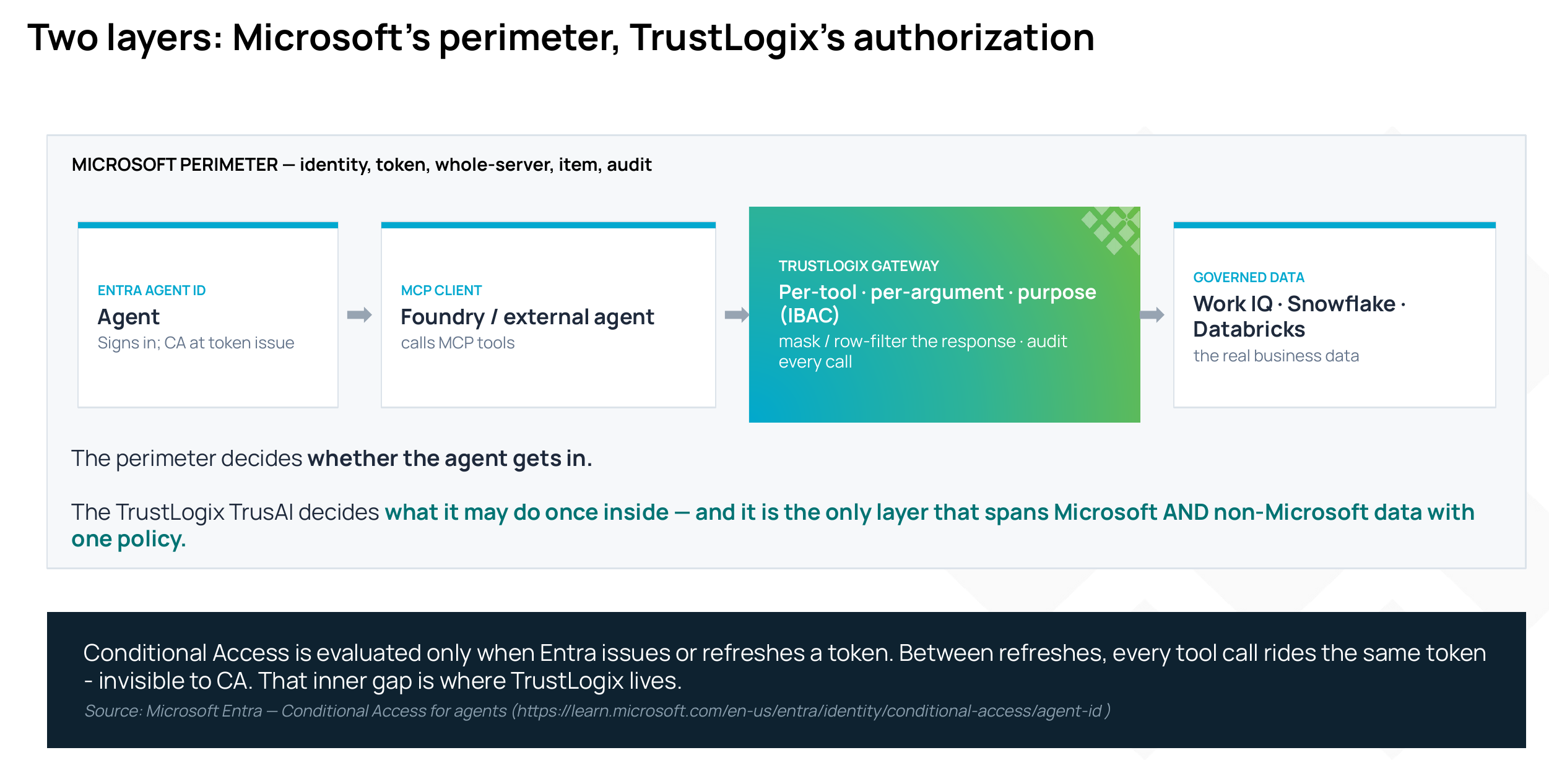
Think of it this way: Microsoft decides whether the agent gets in. TrustLogix decides what it does once it's there, and it's the layer that can apply one policy across Microsoft data and non-Microsoft data (Snowflake, Databricks) at the same time.
A few examples.
Purpose changes the answer, even when the tool doesn't. Picture two identical agents, same instructions, same tool grants, running on different runtimes. One request comes in tagged as ANALYTICS, another as CUSTOMER_SUPPORT. Same call, same data. TrustLogix can return opposite verdicts on the exact same request, because the purpose behind the call is part of the decision. That's the pre-execution "Intent Gate" that OWASP's Agentic Top 10 calls for, and it's the mechanism that keeps a compromised or misdirected agent from pulling firm-wide data just because it technically had the tool grant to do so.
Governance that enables work, not just blocks it. A support agent asking for one customer's case file is doing its job. TrustLogix can allow that targeted read while still keeping the all-customer sweep denied for that same persona. That distinction matters, because controls that only block tend to get worked around, and over-blocking is often what pushes teams toward ungoverned shadow AI in the first place. GDPR's purpose limitation principle exists precisely because the same agent, same data, and same role can be lawful for one purpose and unlawful for another.
Fallback tools don't get a free pass. If an agent is refused on one tool, it will sometimes try a different one to get the same result. TrustLogix evaluates each of those attempts independently, at the call level, with the policy reason returned into the agent's own reasoning. So a targeted find can be allowed while both raw-read paths the agent tries next stay denied.
Reads and writes are authorized separately. An agent that's allowed to read a case file isn't automatically allowed to comment on it, share it, or delete it. TrustLogix treats those as separate decisions, which lines up with OWASP's guidance on per-action authorization through a centralized policy engine.
Masking and row-filtering, not whole-file decisions. Some answers need the useful shape of the data, not the sensitive one. TrustLogix can mask PII and filter rows by entitlement so the response an agent gets back is already scoped correctly, in line with GDPR's data minimization principle and GLBA's requirement to limit access to only what's needed for the task.
Stopping something mid-session, not at the next refresh. Conditional Access is evaluated when a token is issued or refreshed, so a block can take a while to actually land; that's simply how the mechanism works. TrustLogix's kill switch applies at the very next tool call instead, which matters when an agent needs to be stopped in the middle of a run, not at the next natural checkpoint.
Why this matters for agents that live outside the Microsoft ecosystem
A lot of the controls above (content filters, Conditional Access, runtime behavior enforcement) are strongest when an agent's calls are routed through Microsoft's own pipeline. An agent built on a different framework, calling MCP tools directly, won't necessarily traverse those same checkpoints. TrustLogix governs any MCP client the same way regardless: a Foundry agent, a LangGraph agent, a partner's agent, a coding CLI. Governance follows the data, not the framework the agent happens to run on.
That also solves a fragmentation problem. Microsoft Purview can catalog Snowflake and Databricks for lineage, but enforcement at those platforms' runtime stays native to each one.
So without a layer like TrustLogix, "one policy for agents" quietly turns into three separate policies to write, reconcile, and prove: Microsoft, native Snowflake, native Databricks. TrustLogix authors the policy once and enforces it at runtime across all three.
The regulatory backdrop makes this more than a nice-to-have
This isn't just an engineering preference. It's what the regulatory standards are asking for. GDPR Article 5 requires purpose limitation and the ability to demonstrate compliance. The EU AI Act's Article 12 requires high-risk AI systems, including credit-scoring agents, to log events over their lifetime. GLBA's safeguards regime requires limiting access to only the customer information a user needs, and logging that access even when it's permitted. The NSA's 2026 MCP Security guidance is blunt about it: "MCP itself cannot enforce these security principles at the protocol level," and it recommends exactly this kind of middleware layer. OWASP's Agentic Top 10 calls for a pre-execution "Intent Gate" and per-action authorization through a centralized policy engine. None of these are asking enterprises to choose a vendor. They're describing a layer that has to exist somewhere.
Microsoft gets you in; TrustLogix governs what happens next
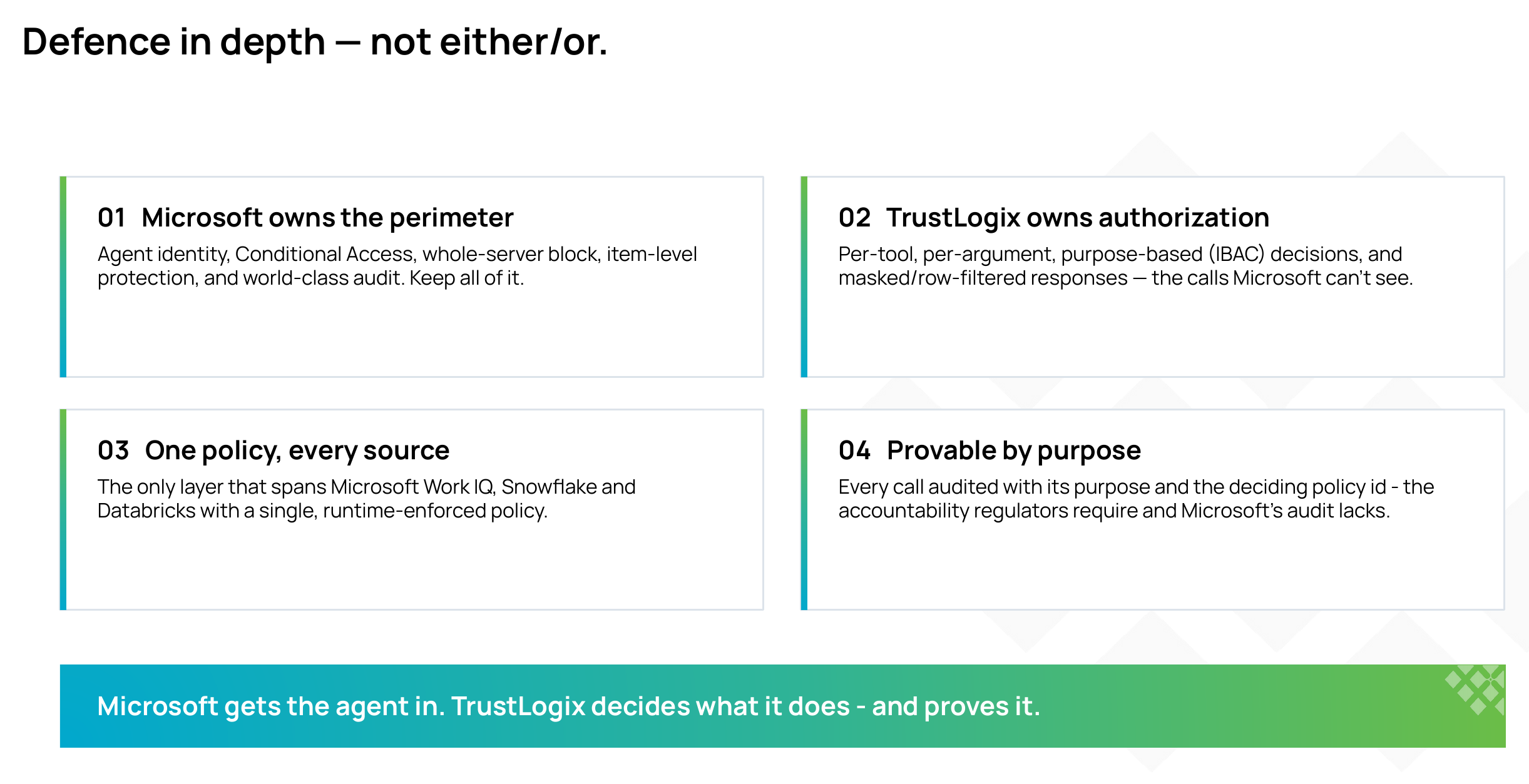
Microsoft owns the perimeter: identity, Conditional Access, whole-server blocking, item-level protection, and strong audit. Keep all of it. TrustLogix owns authorization inside that perimeter: per-tool, per-argument, purpose-based decisions, and masked or row-filtered responses, enforced consistently across Microsoft and non-Microsoft data alike, with every call tied to its purpose and the policy that decided it.
Microsoft gets the agent in. TrustLogix decides what it can do next.
Stay in the Know
Subscribe to Our Blog

.png)
.png)