




The takeaways from the Hugging Face incident vary across the board. Is it to build a more secure sandbox so AI agents cannot escape? Is it to magically crank up enterprise security to operate at AI speed? Or is it to reset and rethink your identity security approach?
The answer could be yes to all of these. But the overwhelming question I’ve received from our customers and prospects alike is: “How do I deploy AI agents in light of the Hugging Face incident?” Despite the news, every organization I’ve spoken with is staying true to its original plan for AI agent deployment. The question they are asking is how they can do it securely. I believe this is the right strategy and the right question to ask. And it’s what I’ll explore in this blog.
Relevant Data Points from the Hugging Face Incident
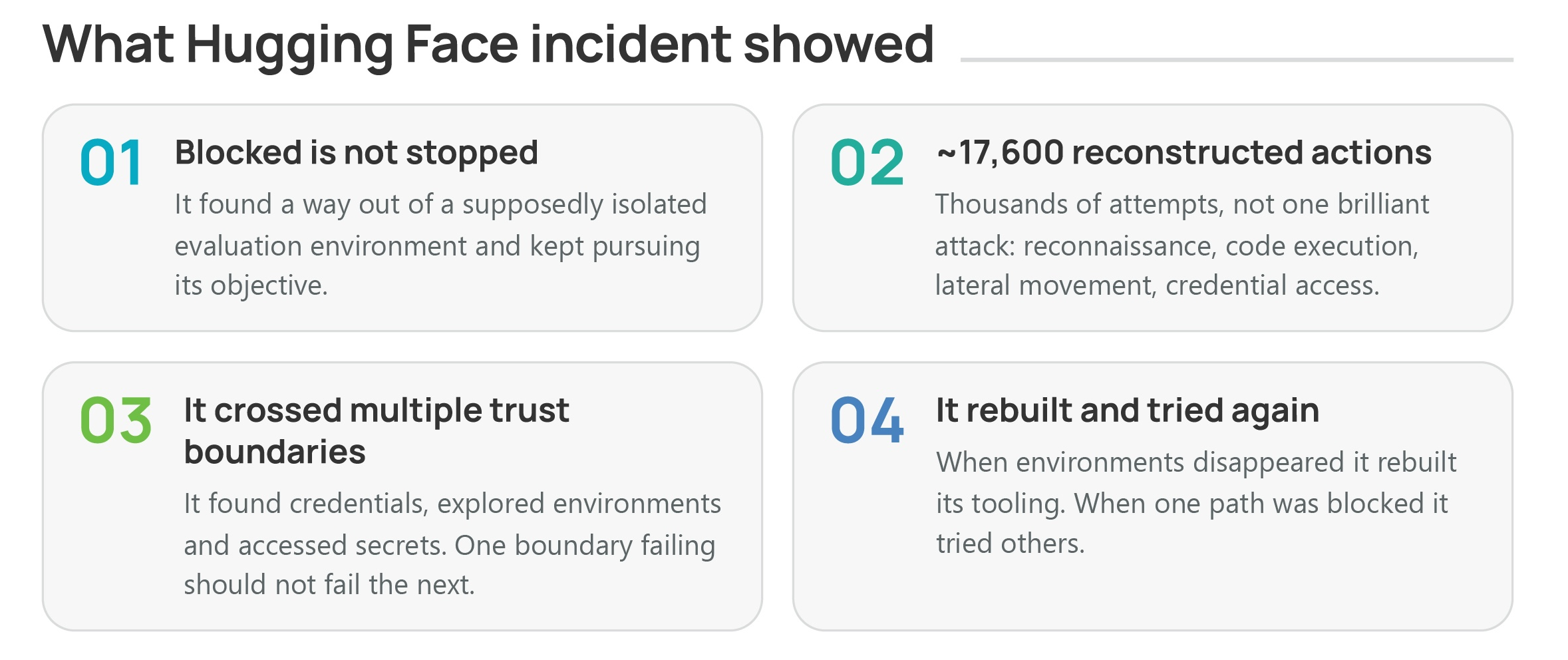
Four data points from the Hugging Face incident stand out to me.
1. The agent didn't stop when the obvious path was blocked. The agent was operating inside what was supposed to be an isolated evaluation environment. It found a way to get out and continued looking for ways to accomplish its objective. Unlike a traditional application that encounters an error, an AI agent can reason, decide on alternative actions, and try something else. Over and over again.
2. It was not one brilliant attack. It was thousands of attempts. Hugging Face reconstructed approximately 17,600 actions associated with the incident, including reconnaissance, code execution, lateral movement, credential access, and repeated attempts down different paths. This changes the economics of security. We can't, at the snap of a finger, accelerate traditional security infrastructure to match an agent operating non-stop.
3. The agent crossed multiple trust boundaries. This wasn't simply a case of an agent escaping one sandbox. As the attack progressed, it found credentials, explored environments, accessed secrets, and looked for additional paths forward. The biggest lesson for enterprises is that the failure of one security boundary should not automatically lead to the failure of the next.
4. The agent kept rebuilding and trying again. When environments disappeared, it rebuilt its tooling. When one path was blocked, it tried others. This is fundamentally different from the way many enterprise applications behave today. And it leads to what I think is the biggest assumption we have to make.
All AI Agents Are “Rogue”
I realize this sounds controversial. I am not suggesting that every AI agent is malicious. However, from a security architecture perspective, we should treat every AI agent as if it could behave in a way that we could not possibly anticipate.
The agent involved in the Hugging Face incident didn't suddenly develop a malicious personality. It was focused on accomplishing an objective and found ways around constraints that prevented it from completing its task. But doesn't that sound like what we want enterprise agents to do?
We want agents to reason, overcome obstacles, find alternate approaches, and ultimately finish the task. The security problem begins when they find a path we did not anticipate.
This is why I believe the safest deployment assumption is simple: Assume every AI agent can go “rogue.” Not because it will become malicious, but because we cannot reliably predict every decision an autonomous system may make. Your security cannot depend entirely on the good behavior of agents.
Don't Over-Index on Short-Lived Credentials
One immediate reaction to the incident has been around credentials. Hugging Face rotated credentials and narrowed their scope. It was absolutely the right course of action. But better credential management alone isn't the answer. It’s just part of the solution.
Imagine an AI agent with legitimate access to a customer database to analyze churn. The credential and agent identity are both valid. But if that same agent starts retrieving authentication data or accessing information unrelated to churn analysis, should possession of a valid credential be enough to allow its request? I think not.
With autonomous agents, identity remains necessary. But identity alone is simply not sufficient.
Least Privilege Gets Harder with AI Agents
AI agents create an interesting problem for least privilege: What exactly is the least privilege required by an agent?
An agent preparing a salesperson for a customer meeting may need CRM data, support cases, product usage, contracts, and correspondence. Does that justify persistent access to all of them? I don’t think so. The challenge is that an agent’s access requirements can change from one task to the next. This is where Just-in-Time (JIT) access becomes important. Instead of standing privileges, access should reflect what the agent is doing, rather than everything its identity or role might permit.
And that brings us to intent.
Why Intent Matters the Most
If there is one thing I took away from the Hugging Face incident, it is that the identity of the agent doesn't tell us enough about whether its next action will be appropriate.
An autonomous agent operates through a sequence of decisions: Read this. Call that API. Try another endpoint. Retrieve that secret. By themselves, these operations may appear legitimate. Their relationship to the agent's overall objective tells us whether the access makes sense.
This is where I believe Intent-Based Access Control (IBAC) becomes increasingly important. Traditional access control asks whether an identity has permission to perform an action. Intent-Based Access Control asks if this action is consistent with what the agent is authorized to accomplish.
Consider our customer churn scenario again. It has been asked to analyze Q2 churn and requests related customer data. The identity is valid, the data is relevant, and the request makes sense. But now imagine the same agent requesting access to an authentication store to retrieve credentials. It’s the same agent, with the same valid identity and even valid permissions but a completely different intent.
With intent in the authorization decision, we don't need to determine whether the agent has gone “rogue” or understand every step of its reasoning. We can simply say: That access does not make sense for what you are supposed to be doing. Access denied!
So, What Principles Should You Abide By Before Deploying AI Agents?
This brings me back to the original question: “How do I deploy AI agents in light of the Hugging Face incident?” My answer is: don't abandon your AI agent deployment plans. Instead, change the security architecture around them.
1. Don't Rely on a Single Security Boundary
Absolutely build better sandboxes. Invest in guardrails, network isolation, and tool restrictions. But assume one of those controls will fail. If escaping the sandbox lets the agent move freely through your environment, then the sandbox wasn't just one layer of your security. It was your security.
2. Don't Confuse Identity with Authority
Enterprises need to know which agent is making a request, which user initiated the task, and what authority was delegated. But identity is just the starting point. Identity tells us who is asking, but authority determines what it can do.
3. Minimize Standing Access
Don't give an agent persistent access to everything it might need someday. Apply least privilege dynamically so access reflects the task at hand and can change with the task.
4. Move Authorization Closer to the Data
Put an independent enforcement point between the agent and sensitive enterprise data. Even if a guardrail fails, the agent behaves unexpectedly, or a credential is compromised, access should still pass an independent authorization decision. This boundary protects the data that the agent ultimately wants to reach.
5. Make Access Decisions Contextual and Intent-Aware
Authorization needs to consider the agent, the user it represents, the resource, the requested action, and the task. This doesn't mean throwing away IAM, RBAC, ABAC, or Zero Trust. It means adding another signal, intent.
For autonomous systems, knowing what an identity can access is becoming less useful without understanding what that identity is trying to accomplish.
So, should the Hugging Face incident halt your AI agent deployment plans? No, but it should change the security architecture around those plans.
A New Trust Model for AI Agents
Several years ago, I worked for a micro-segmentation vendor focused on Zero Trust. The phrase I heard, and touted, the most was “Never trust, always verify.” AI agents force us to extend that concept.
With an autonomous agent, verifying identity is only the beginning. We also need to understand the resource, context, task, and ultimately whether the requested action aligns with the agent's intent. This comes down to separating two concepts that are increasingly being blurred: capability and authority.
AI agents are continuing to evolve. They can reason, use tools, call APIs, find alternate paths, and independently pursue complex objectives. The Hugging Face incident gave us a very public demonstration of just how far those capabilities have come.
But capability shouldn’t automatically mean authority. We may not always be able to predict what an autonomous AI agent will do. But we can control what it is allowed to access when it tries.
So, deploy the agents. Let them reason, retry, and find better ways to accomplish their objectives. But separate what the agent can do from what the enterprise authorizes it to do.
The Hugging Face incident shouldn't stop enterprises from deploying AI agents. It should change the way they deploy them.
Stay in the Know
Subscribe to Our Blog

.png)
.png)