




An AI agent blind spot is the inability to trace which autonomous agent accessed which data, on whose behalf, and under what authority, in real time. Most financial services firms have one. Few know it.
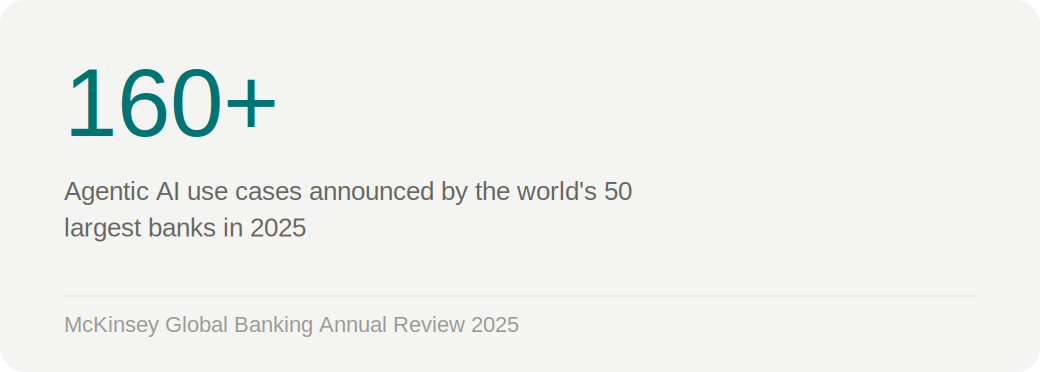
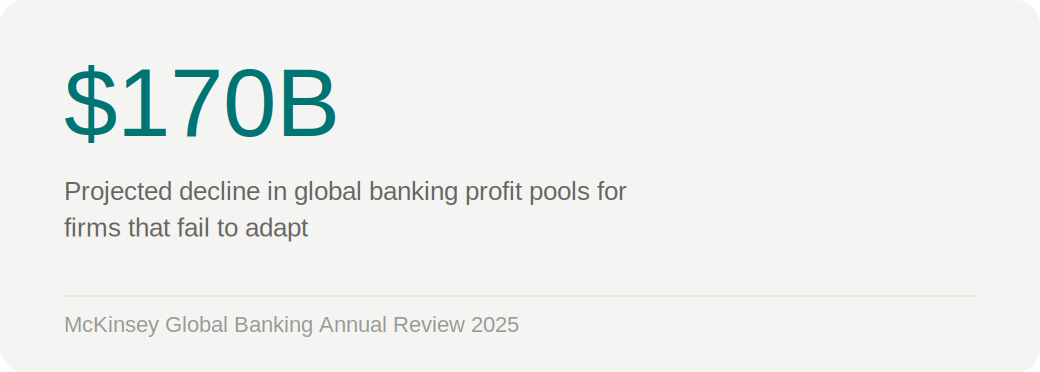
In 2025, the world's 50 largest banks announced more than 160 agentic AI use cases, spanning fraud detection, trade analytics, compliance automation, and customer operations. McKinsey projects that banks failing to adapt their business models to this shift could see global profit pools shrink by $170 billion over the next decade. The pressure to move fast is real, and the industry is responding.
What hasn't kept pace is the infrastructure to govern what those agents actually do once they're deployed.
The Agentic AI Security Gap in Financial Services
When a financial services firm deploys an AI agent, that agent needs data access to do its job. In most architectures today, it gets that access through a service account, often with credentials that are broad, persistent, and shared across multiple agents and workflows. The agent can query Snowflake, pull from SQL Server, reach into S3 and OneDrive, all under the same set of permissions, with no time limits, no purpose constraints, and no behavioral monitoring in place.
That's not a misconfiguration. It's how most agentic architectures are built today, because the tools designed to manage access weren't built with autonomous, non-human actors in mind.
The result is what we call the agent blind spot: security and compliance teams have no way to answer the question regulators are increasingly going to ask. Which agent accessed which data, on whose behalf, and why?
The Financial Services Risk by the Numbers
The IBM/Ponemon 2025 Cost of a Data Breach Report found that 97% of organizations that experienced an AI-related breach had no proper access controls on their AI systems. Shadow AI incidents added an average of $670,000 to breach costs. And 87% of organizations report having no AI governance policies or processes in place at all.
For financial services specifically, the stakes are higher. The U.S. average breach cost hit an all-time high of $10.22 million in 2025, driven in part by steeper regulatory penalties. Malicious insider attacks, the category that ungoverned AI agents most closely resemble from a risk profile standpoint, cost an average of $4.92 million per incident.


How Financial Services Regulators Are Responding to Agentic AI Risk
For the first time, FINRA's 2026 Annual Regulatory Oversight Report dedicates a full section to AI agents, classifying them as a distinct supervisory risk category. The report identifies four specific vectors: agents acting without human validation; scope and authority exceeding what users intended; auditability challenges in multi-step reasoning chains; and potential misuse of sensitive client data.
The framing matters. FINRA isn't treating agentic AI as a future concern. It's treating it as a present one, with current compliance obligations attached.
The core problem regulators are circling is accountability. Traditional supervisory models are built around human intent and human decision-making. When an AI agent retrieves client financial data, executes a workflow, and produces an output, the accountability chain breaks unless the underlying infrastructure was built to preserve it. Who authorized that access? What data was touched? Can a compliance officer reconstruct that interaction if asked to?
For most firms today, the answer is no.
Agentic AI Security in Financial Services: A Real-World Example
A leading financial services institution partnered with TrustLogix to scale agentic AI across its internal operations, deploying dozens of purpose-built micro-agents for automation, analytics, and decision support. Before TrustLogix, the firm faced a version of this problem that's increasingly common: AI agents and service accounts had inherited overly broad privileges across a fragmented data estate spanning legacy on-premises databases, Snowflake, AWS S3, and OneDrive. The firm had no way to demonstrate to auditors how sensitive financial and personal data was accessed or processed by autonomous agents, and agentic AI projects were at risk of being paused entirely by security and legal teams.
The challenge wasn't ambition or technical capability. It was visibility: no existing tool could trace the chain from human requester to agent to query to data, or enforce controls at that level of granularity.
How TrustLogix Closes the Gap
TrustAI by TrustLogix serves as the centralized authorization layer between enterprise data platforms and AI frameworks, evaluating every data request made by an AI agent before data is returned. It enforces the complete accountability chain: User → Agent → Query → Data. Every interaction is logged, auditable, and mapped to policy.
In practice, that means several things. Every AI agent inherits only the specific, scoped entitlements of the human who initiated the request, not the broad credentials of a service account. Access is granted on a just-in-time basis, scoped to the specific purpose and duration of the task, then automatically revoked. Sensitive fields are masked or filtered natively at the data source before data ever enters the agent's context. And TrustAI's behavioral baselining continuously monitors agent activity, flagging deviations in real time and streaming alerts to SIEM platforms and Microsoft Teams for immediate investigation.
For the financial services firm in our case study, the results were immediate. AI engineers were able to build and deploy new agents with immediate security approval, using no-code policy frameworks that put control in the hands of data owners. Analysts can now investigate compliance questions in plain language: "Which agent queries violated our data confidentiality policies?" The firm can demonstrate to auditors exactly how sensitive financial data was accessed, by which agent, on behalf of which user, against which dataset. The audit gap is closed.
Provisioning time dropped from weeks to minutes. Remediation of misconfigured agents accelerated by 90%. And critically, the firm's agentic AI program scaled rather than being blocked by security teams who had no other option than to slow things down.
The Question Worth Asking Now
Gartner has warned that humans can't govern at machine speed. That framing captures the core tension: AI agents operate in milliseconds, across dozens of data sources simultaneously, without pausing for a human to review what they're doing. The governance infrastructure has to match that pace, or it doesn't work.
The firms that will scale agentic AI successfully in financial services are the ones building that infrastructure now, before a breach or a failed audit forces the issue. Security and AI adoption are not in tension. The right data security infrastructure is what makes adoption defensible, and what keeps it moving.
Can your security team trace every query an AI agent ran last Tuesday: on whose behalf, against which dataset, under what entitlement? If not, that's the blind spot worth closing.
See how TrustLogix secures agentic AI for financial services firms. Request a demo.
Stay in the Know
Subscribe to Our Blog


.png)