


.png)

Policy-based access control (PBAC) is a dynamic authorization model that grants or restricts data access based on a combination of user identity, data sensitivity, agent purpose, and real-time business context, rather than static role assignments alone. For enterprises running autonomous AI pipelines through Snowflake Cortex or Databricks Genie, PBAC is no longer optional: it is the security layer these platforms were not built to provide on their own.
Snowflake Cortex and Databricks Genie have made AI accessible to anyone in the enterprise. Users can query complex datasets in plain English, get instant answers across databases and schemas, and bypass SQL entirely. The productivity gains are real. So is the security gap. Both platforms rely on traditional RBAC and ABAC models designed for human-paced interactions. Autonomous AI agents operate at machine speed though, chaining multi-step reasoning across datasets in ways those native controls were never designed to govern. The result: fragmented visibility, over-permissioned agents, and risk that scales with every new pipeline you deploy.
The Two Problems Enterprises Face
Two categories of risk define what happens when AI pipelines outpace native platform controls.
1. Fragmented Visibility
Consider a data-driven enterprise with information distributed across cloud and on-premise environments: network performance metrics in Snowflake, customer support logs in Databricks, sensitive employee records in MySQL. One morning, the CEO requests an urgent cross-functional report on how network outages are impacting customer satisfaction. Instead of laboring over complex SQL joins, an analyst toggles between Cortex and Genie, uses natural language prompts to gather insights across platforms in seconds, and delivers answers that would have taken days. It looks like a masterclass in productivity.
The blind spot lies beneath it.
Are privacy policies consistent across these platforms? How can you guarantee data remains secure when accessed by an autonomous AI agent rather than a human? If you deploy a custom Streamlit application as an internal AI interface, that application becomes a third attack vector: one with no native policy enforcement, no unified visibility, and no connection to the controls governing Cortex or Genie. Without a unified enforcement layer, you are not just accelerating insights: you are accelerating risk.
TrustAI addresses this directly. As a unified control plane across Snowflake and Databricks, it ensures the ABAC policies governing Cortex and Genie agents are always driven by the latest business context, not static role assignments. Define a policy once; TrustLogix enforces it whether the query originates from a Snowflake Cortex Analyst or a Databricks Genie space.
2. AI at Machine Speed, Security at Human Speed
Snowflake Cortex and Databricks Genie still rely on traditional RBAC and ABAC models designed for human-paced interactions. AI agents operate at machine speed. They perform multi-step reasoning to answer complex questions, and they are designed to be too helpful. That combination creates real exposure: agents can join disparate tables, infer sensitive insights, and act on data in ways that outpace any manual review process.
Machine-speed AI requires machine-speed security. That is exactly what PBAC provides. With TrustLogix's dual-pillar approach, TrustAccess and TrustAI, you can define policies based on the specific purpose of the agent and the real-time attributes of the user. Enterprises using TrustLogix have reduced access remediation time by 90% and cut provisioning cycles from weeks to minutes.
Enforcing Least-Privilege Access Across AI Pipelines
At the core of PBAC is least-privilege access: every agent request is scoped to the minimum data required based on user identity, agent intent, and business context. In AI-driven environments, over-provisioned access is exponentially more dangerous because agents can traverse data and infer insights across systems faster than any security team can track.
TrustLogix enforces least-privilege dynamically through PBAC and ABAC, preventing unintended data exposure while enabling powerful, multi-step AI workflows. This architecture holds across complex multi-agent ecosystems as well. Whether you are using Cortex, Genie, Claude, ChatGPT, or a custom in-house build, every agent operates within the centralized guardrails defined in TrustLogix.
How TrustAI Works with Snowflake Cortex and Databricks Genie
TrustLogix enforces least-privilege by simultaneously honoring two access contexts: the end-user context (who is asking) and the agent context (what the agent is programmed to do). This dual-layer validation prevents an agent from over-reaching. Even if the user holds broad permissions, the agent is restricted to the specific data necessary for its defined purpose.
For managed agents like Snowflake Cortex and Databricks Genie, TrustAccess acts as the orchestration engine. It continuously synchronizes business attributes, such as project codes or clearance levels, from external tools into Snowflake Horizon and Databricks Unity Catalog. As a user's business context changes, their AI agent's permissions update automatically.
For custom agents built on frameworks like LangChain or AgentBricks, TrustAI's MCP Gateway handles enforcement. These agents send a real-time request to TrustAI's MCP server before executing any tool or data call. TrustLogix evaluates the specific purpose of that sub-task against the active security policy, granting or denying access at machine speed.
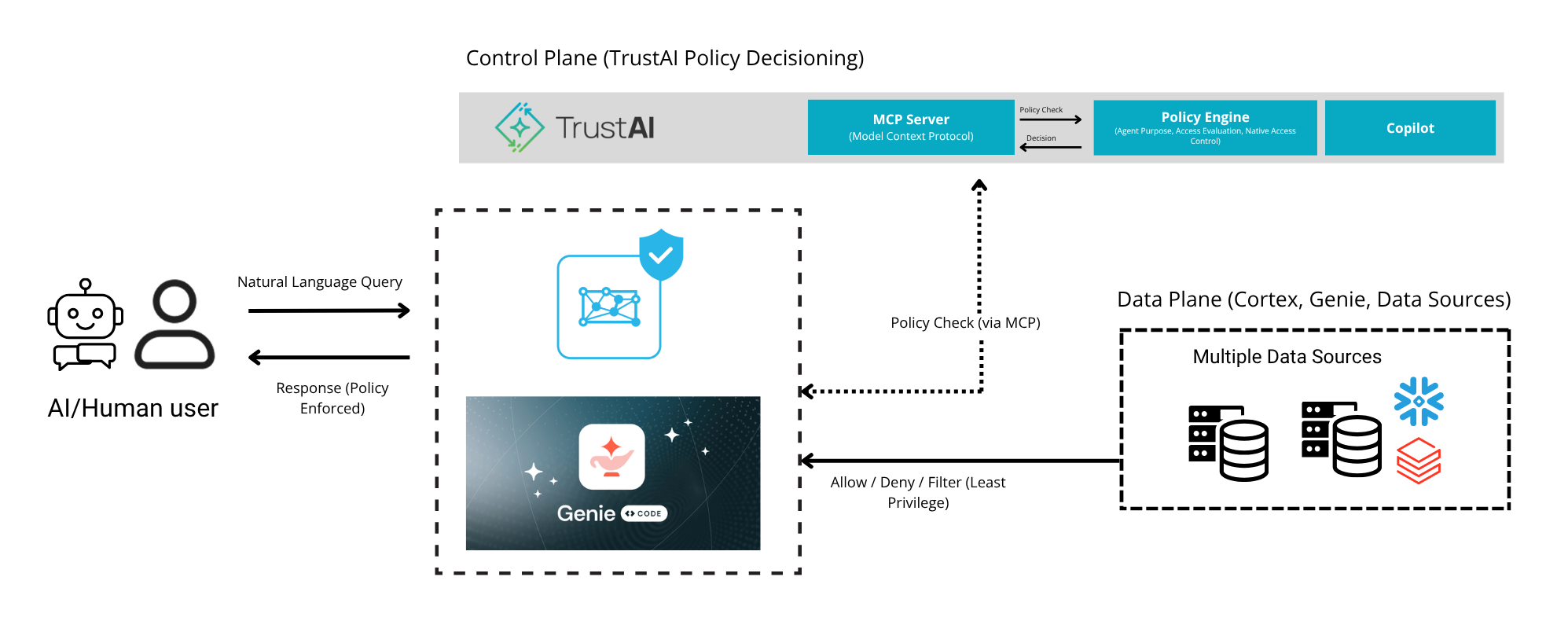
Dynamic Policy Enforcement: How It Works
- Agent Registration: Captures the identity and specific purpose of each agent to define the security perimeter.
- Contextual Access Control: Grants access based on a combination of purpose, user attributes, and resource attributes rather than static roles alone.
- Real-Time Evaluation: Verifies database access and agent permissions before invoking Snowflake Cortex or Databricks Genie.
- Continuous Audit: Logs every data interaction with full context, including who accessed what, when, and why, providing compliance-ready trails for SOX, GDPR, and HIPAA.
Bringing Trust to Enterprise AI Pipelines
Snowflake Cortex and Databricks Genie make AI accessible and powerful. TrustAI ensures those capabilities are trusted, governed, and enterprise-ready.
TrustLogix is not a replacement for native platform capabilities. It is a complementary trust layer that helps enterprises scale AI pipelines safely across Databricks, Snowflake, and beyond. Security applied at machine speed, with full context, is what lets AI move faster with confidence. TrustAI enables enterprises to adopt AI responsibly: accelerating the pipelines that drive the business while ensuring every agent, query, and data interaction stays within the guardrails you define.
Stay in the Know
Subscribe to Our Blog


.png)